
Webinar Recap: How Targeted Messaging Increases Engagement

Getting information in the right hands at the right time can be critical to the effectiveness of a message. Granicus’ Targeted Messaging Service (TMS) balances the delicate “signal versus noise” issue many communications teams struggle with: how to keep people informed on what is relevant without overwhelming them with “noise,” or extra information that clogs the messaging pipeline.

During the TMS: Transactional Messaging webinar on November 7, Granicus Technical Implementation Consultant Richard Fong and Solutions Engineer Shawn Pillow highlighted how personalized messages, or one-to-one messaging, expands an organization’s reach, whether it’s through routine updates or in the case of critical information dissemination. One-to-one messaging is tailored to the recipient through GovDelivery Communications Cloud, even in cases of high volume messaging like during a large scale crisis or when trying to reach groups of license holders about upcoming expirations.

How does it work?

TMS is a pure Application Programming Interface (API) product that facilitates the exchange and integration of data. “It can and does provide a richer and better user experience,” Fong said. “API is everywhere, and you, as a consumer, encounter it every day.”

Powerhouses like Google, Twitter and Amazon use APIs to embed features on their sites or make products more accessible. TMS uses APIs to provide access to Granicus’ sending and processing infrastructure.
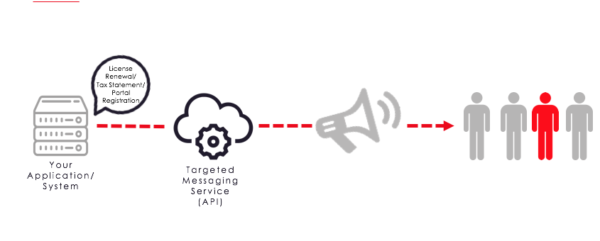
TMS’s scalability and metric reporting sets it apart as an industry gold standard. As an automated messaging system, TMS can be scaled for a small handful of readers or millions of recipients. Afterwards, the software collects data on how many inboxes were successfully hit, along with open and click data to paint a picture of how efficient the messaging style was.

Who does it serve?

“Being able to connect with an audience consistently at a huge scale lets [organizations] make a real impact,” Pillow explained.

As an example, the National Highway Traffic Safety Administration wanted to increase the number of citizens taking action on recalled vehicles. With only 70 percent of recalled vehicles ever being repaired, it became a critical matter of life or death. By implementing TMS through GovDelivery Communications Cloud, the NHTSA saw a 1,700 percent increase in subscribers to recall notifications in August of 2017 alone. Since implementing the Communications Cloud software, the NHTSA has continued to see 10 times more subscriptions to updates per month.

“Getting the right information in the right hands can be a life saver,” Pillow said. And, while some information can be the difference between a safe drive home and becoming another statistic in road collisions, TMS has obvious email, voice and text messaging applications for everyday activities like appointment reminders, license renewals and bill payment reminders.

Making life more automated through targeted messaging not only improves business processes, but simplifies consumer’s lives, making them more likely to trust the companies and governments that serve them.

How is TMS implemented?

Improving the customer and employee experience requires no extra work with Granicus’ Communications Cloud TMS implementation. With ReST (Representational State Transfer) architecture, developers can implement TMS into their framework of choice (Python, Java, Ruby, etc).

Template features help define the body and subject of the message beforehand, decreasing bandwidth requirements and improving high volume send rates. “We’ve updated our template capability to allow for smart templates which include if/then branch logic,” Fong added.
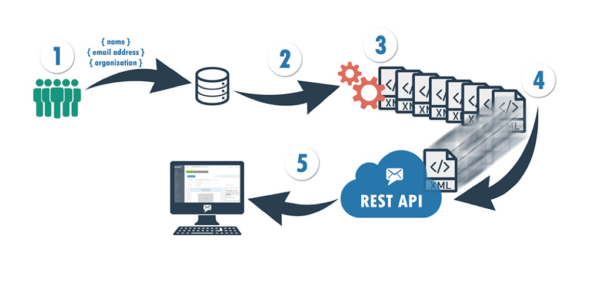
API Graphic

TMS’s success relies on its deliverability and security to be considered a reliable resource for organizations. Messages sent through TMS are not sorted into a promotional or spam folder, but head directly to the recipients inbox, making it a priority to be seen. As a FedRAMP-compliant software, the data in Communications Cloud used for TMS is protected from malware.

Targeted messaging has multiple applications for local, statewide and federal agencies. If you missed the TMS webinar on November 7, catch it on demand here. For more information about targeted messaging, be sure to connect with us at info@granicus.com.

This post was originally published on Granicus.com

Night Market season kicks off along Roxborough’s Ridge Avenue

l_image1-9

Philadelphia’s first Night Market of 2016 kicked off on Ridge Avenue in Roxborough on Thursday night.

The annual food truck-centric event sponsored by the Food Trust drew in a crowd of approximately 25,000 people from varying neighborhoods in the city, Food Trust communications manager Carolyn Huckabay said.

“The goal of Night Market is to get people to parts of Philly they might not know,” Huckabay said. “We always try to work with a community organization. Communities, like Roxborough, usually want people to come.”

Philadelphia’s Night Market is sponsored by the Food Trust, a nonprofit group dedicated to providing healthy, affordable food for economically disadvantaged regions. The group was founded in Philadelphia in 1992 and offers a variety of programs, including hosting farmers markets and providing nutrition education.

The Night Market works with local business owners along with food trucks from around Philadelphia to coordinate the annual events. Taking place in new neighborhoods each year, the Night Market tends to draw in people who rarely visit the area where it is hosted.

The market locations are usually posted several months in advance, with the exception of this summer. The next two markets will be held in West Philly and Callowhill, but the final market of the season in October has yet to be announced, as a sort of experiment to “see what happens,” Huckabay said.

This story originally appeared on Newsworks.org

Cunningham Piano Company hosted ‘Rolls Royce’ of pianos

l_dsc_0499

Cunningham Piano Company of Germantown, an award winning piano group, was home to a rare Bosendorfer piano, the Opus No. 50000, last month.

Bosendorfer produces roughly 300 pianos per year, and the prestigious company, after more than 120 years in business, created a gold plated piece to be presented at various piano companies around the country.

“We’ve had a few things like this before, but this is an extremely rare piano,” co-owner of Cunningham Piano, Rich Galassini, said. “It’s certainly one of the top. It’s one of the best things I’ve been a part of.”

Galassini said he believes access to a fine Bosendorfer piano could inspire young musicians to continue to pursue the art.

“The labor is the slowest and most careful in the world,” Galassini said. “It takes 10 years to make and producers must spend years learning how to produce the piece.”

The piano company currently houses roughly ten other Bosendorfer pianos in their shop, but the Opus 50000 is one of the rarest pieces to have ever been in the shop.

“The Bosendorfer has been called the ‘Rolls Royce’ of pianos,” Galassini added.

Pints for North Light raises funds for local community center

North Light Community Center hosted its seventh annual silent auction at Manayunk Brewery and Restaurant on Thursday night.

The event, Pints for North Light, drew huge crowds onto the second floor of the restaurant, packing the space while folks bid on baskets of various goodies and chugged beer and spirits from local breweries.

The organization hosts several events throughout the year, raising about 90 percent of their $1 million budget through charitable events, North Light director Dana Dabek said.

North Light Community Center focuses on providing services requested by the Northwest community. Childcare and emergency management, like utility services and groceries, are among the more popular needs discovered through surveys, focus groups and interviews with community leaders, Dabek said.

“We are one of the organizations that adapts to the needs of the community,” Father Kirk Berlenbach, who works with the organization, said. “One of the main focuses is working with children.”

The center, founded in 1936, began as a boys club and has since continued to work with youth and adolescents to provide programs to keep teens in a safe, stable and stimulating environment.

The 2015 Pints for North Light was the first year the event completely sold out, Debrek noted. “It’s a program that grew organically,” she said.

Going forward, the community center is planning to expand their network of services to include more members of the Northwest Philadelphia community.

“We have a program coming up called ‘Manayunk Meals’ to donate food and meals to homebound seniors,” Berlenbach said.

This story originally appeared on Newsworks.org

On heels of St. Mary’s closure, Manayunk’s St. John the Baptist faced with major building repairs

St. John the Baptist Church in Manayunk, also known as “Manayunk’s Cathedral,” is calling on its parishioners and local community members to help raise $1 million to repair the crumbling façade of the building.

Officials with the church raised concerns over the building’s decaying features, like the steeple and roof, in 2014 and have continued to campaign for more funds to restore the historic site.

“This is about restoring not just a building, but a community,” Monsignor Kevin Lawrence said. “This is a place we look to for a great future.”

The St. John the Baptist parish, which merged with St. Mary of the Assumption Church in July 2012, lost more than $142,000 last fiscal year.

Leaders of the campaign are optimistic about the restoration, but are quick to remind churchgoers that the task ahead is large.

“This is a major capital campaign,” said Catholic Foundation of Greater Philadelphia’s Scott Bucko, who has been charged with leading the campaign. “This is not a ‘second collection’ where you might drop in five dollars.”

The church and social hall will remain open during renovations, Lawrence said. With winter quickly approaching, the church is hoping to complete construction by February.

The $1 million campaign is phase one in a two-part approach to restoring the building. The second phase will look at repairs like fixing stained glass and painting the interior.

Originally published for Newsworks.org